Why Is My Cat Shedding So Much?
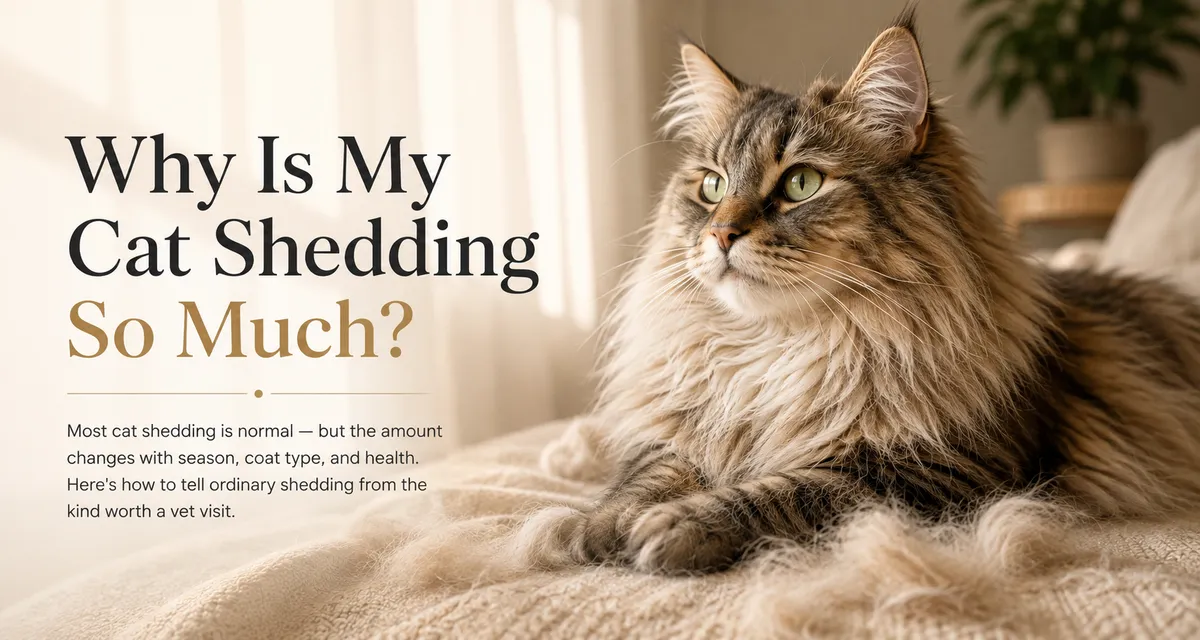
If you're finding fur on your clothes, your couch, and somehow inside a closed drawer, you're not imagining it — and your cat is probably fine.
Cats shed constantly. It's how they replace fur that's reached the end of its life cycle. But the amount changes with the season, the breed, the light in your home, and sometimes with your cat's health. Knowing which is which saves you a lot of unnecessary worry.
Why cats shed in the first place
Every hair on your cat grows, rests, and eventually falls out. New fur pushes the old fur loose, and that loose fur ends up either on your furniture or on your cat's tongue during self-grooming.
Outdoor cats follow a fairly clear rhythm: heavier shedding in spring as the winter coat comes out, and again in fall as the summer coat gives way to something denser. Daylight drives this. As days get longer or shorter, the coat adjusts.
Why indoor cats seem to shed all year
Here's the part that surprises most owners. Indoor cats live under artificial light and steady temperatures, which blurs the seasonal signal their body uses to time coat changes. Instead of two heavy sheds a year, you get a moderate shed that never really stops.
So if you've been waiting for shedding season to end and it hasn't — that's why. For an indoor cat, it's more or less always shedding season.
Long-haired cats: more visible, not necessarily more fur
Maine Coons, Persians, Ragdolls, Norwegian Forest Cats. Owners of these breeds tend to assume their cat sheds more than a short-haired cat.
It's mostly an illusion. Long-haired cats shed a comparable amount of hair — each strand is just longer, more visible, and more likely to clump together on a dark rug. What is genuinely different is that long fur tangles. Loose hair gets trapped in the coat instead of falling out, and if it stays there it starts forming mats close to the skin.
That's the real reason long-haired cats need more frequent brushing. Not because they shed more, but because their coat holds onto what they shed.
Those three breeds don't actually share a coat, and the routine differs more than most owners expect — what a Maine Coon, Persian and Ragdoll each need breaks down the differences.
What actually reduces the fur in your home
Nothing stops shedding — it's a biological process, not a problem to be solved. What you can change is where the fur ends up.
Brush regularly. This is the whole ballgame. Loose fur that you remove with a brush is fur that never lands on your sofa and never gets swallowed. Long-haired cats do well with several sessions a week; short-haired cats usually need less. Our guide to how to reduce cat shedding at home covers the routine in more detail.
Keep sessions short. Cats have a limit, and pushing past it makes the next session harder. Five focused minutes beats twenty stressful ones. If your cat actively objects, the approach in brushing a cat that hates it is worth reading before you try again.
Support the coat from the inside. Hydration and a complete diet affect coat condition. A cat that isn't drinking enough or is missing key nutrients often has a duller, more brittle coat that sheds more readily. Your vet is the right person to ask about specifics.
Use the right tool for the coat. A tool that only skims the surface won't reach loose undercoat fur, which is where most of the shedding volume actually sits. For coats that shed heavily, an undercoat-focused grooming edge does more than a surface brush — which is what the PASLUNA brush is designed for.
Which of those two you reach for depends on what the coat is doing: one that knots needs different handling from one that simply drops undercoat. If you're weighing them against each other, how a slicker brush and a deshedding tool differ for cats sets out the distinction.
Hairballs and shedding are the same problem
When your cat grooms itself, it swallows the loose fur it removes. Most of that passes through. Some of it collects in the stomach and comes back up.
More loose fur in the coat means more fur swallowed. So brushing isn't only about your furniture — it directly reduces how much hair your cat ingests. Owners who start brushing consistently often notice the hairball frequency drop, and that's the mechanism.
When shedding is worth a vet visit
Most shedding is ordinary. These signs are not:
- Bald patches or thinning areas, especially symmetrical ones
- Red, flaky, or irritated skin under the fur
- Obsessive grooming focused on one spot
- A sudden change in how much your cat sheds, without a seasonal explanation
- Fur that pulls out easily in clumps
Stress, allergies, parasites, and thyroid conditions can all show up first in the coat. If something has changed and you can't explain it, that's a conversation with your vet rather than a grooming problem.
The short version
Your cat is shedding because that's what cats do, and an indoor cat doing it year-round is normal rather than alarming. The fur volume you're dealing with is largely a function of coat type and how often you brush.
You can't switch shedding off. You can decide whether the loose fur comes out on a brush or on your black jeans.
Key Takeaways
- Year-round shedding is normal for most indoor cats because artificial light disrupts the seasonal coat cycle.
- Long-haired breeds like Maine Coons and Persians shed the same amount as short-haired cats — the fur is just more visible.
- Regular brushing removes loose fur before it lands on furniture or gets swallowed during self-grooming.
- Sudden shedding changes, bald patches, or over-grooming are worth raising with a vet.
Frequently asked

The PASLUNA Editorial Team creates expert-backed educational content focused on pet grooming, coat care, shedding management, and pet wellness for dogs and cats.
 Cat Grooming
How to Reduce Cat Shedding at Home
A calm, practical routine for managing cat shedding — what actually helps, what doesn't, and when loose fur is worth a vet's attention.
 Cat Grooming
How to Brush a Cat Without Stress
How to brush a cat calmly — reading her signals, choosing the right moment, and short gentle sessions that work even for cats who hate it.
 Cat Grooming
How to Brush a Cat That Hates It
A patient, low-stress method for cats who fight the brush — reading the warning signs, building tolerance over days, and knowing when resistance means pain.