Maine Coon, Persian & Ragdoll: What Each Coat Actually Needs
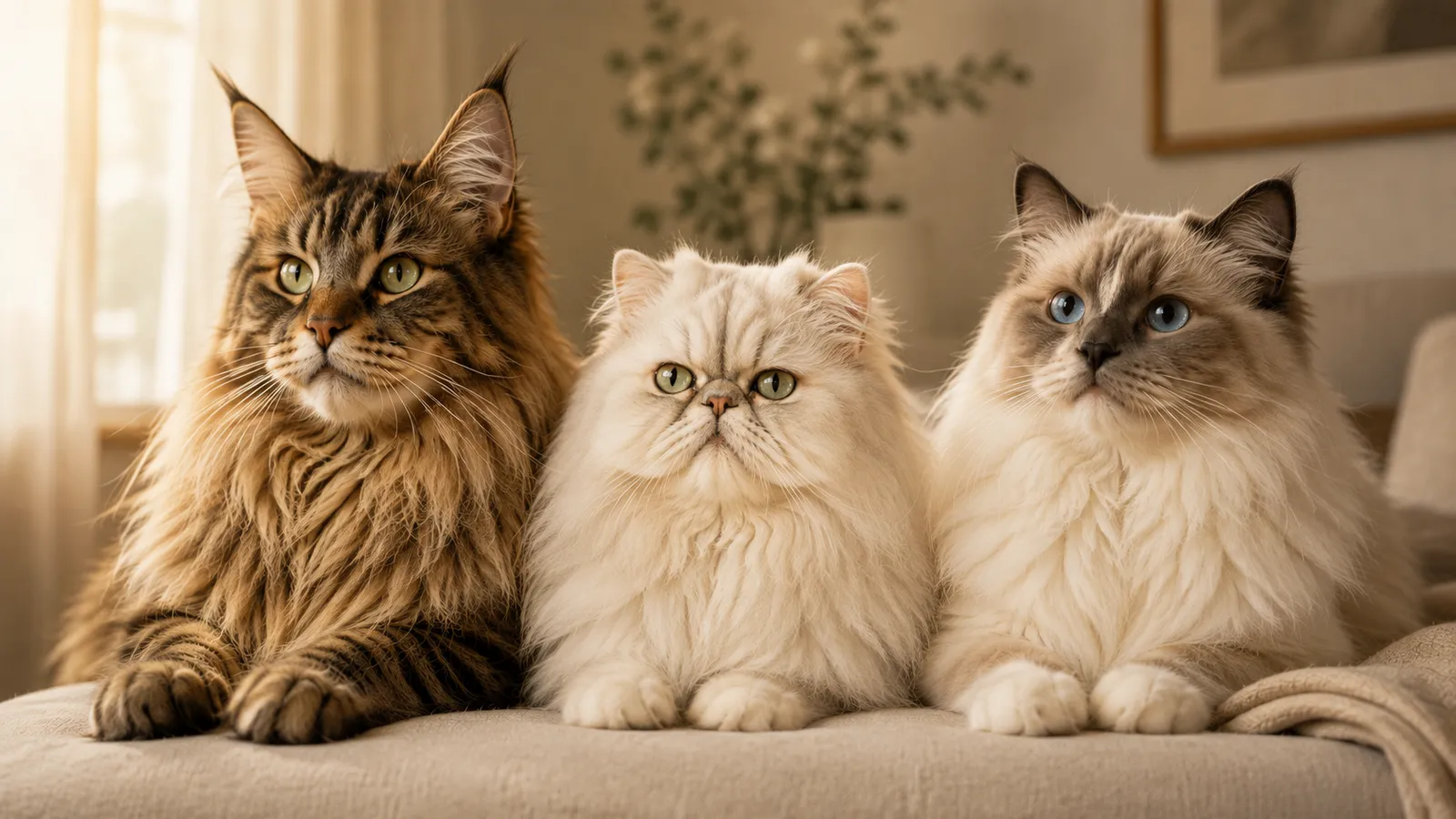
"Long-haired cat" gets treated as one category. It is not. A Maine Coon, a Persian, and a Ragdoll have genuinely different coats, and the routine that keeps one of them comfortable will leave another matted.
The variable that matters is not length. It is undercoat — how much of it there is, how fine it is, and how readily it stays trapped in the coat instead of working its way out.
What does a Maine Coon's coat actually need?
Two to three sessions a week for most of the year, moving toward daily during the spring and autumn sheds.
A Maine Coon's coat is uneven by design: shorter over the shoulders, longer down the flanks and britches, with a pronounced ruff and a coarse, slightly water-resistant topcoat over dense undercoat.
That coarse topcoat is the useful part. It lets loose undercoat work its way outward rather than holding it against the skin, which is why Maine Coons shed spectacularly but mat less readily than a Persian of similar length.
Where owners go wrong is coverage. The back and flanks get brushed because that is where the cat is happiest being touched. The britches, the dense hair under the chin, and the ruff get skipped — and those are where the coat compacts.
Why does a Persian mat so quickly?
Because Persian undercoat is unusually fine and dense, and the topcoat lacks the coarseness that helps shed hair escape.
The result is that loose hair stays in the coat. It does not drift onto your sofa the way it does with other breeds. It works down toward the skin, tangles with the live hair around it, and compresses. A Persian can go from a smooth coat to a mat you cannot comb through in under a week.
This is the breed where a missed week creates real work, so daily — or as close to daily as you can sustain — is the honest answer on frequency.
The armpits and belly are the blind spots. Both are friction points, both are places a Persian's flat face makes self-grooming inefficient, and both are the last places most owners check.
Do Ragdolls need less grooming than they look like they need?
Usually, yes. Ragdolls look like they should be the hardest of the three and generally are not.
The coat is long and silky but carries comparatively little undercoat, and undercoat drives both shedding volume and matting. Less of it means less to trap, and less to felt.
That does not mean no grooming. Ragdolls still shed, still tangle at the ruff, and still need the friction points checked. Two to three sessions a week is usually enough. The risk with this breed is complacency: the coat forgives a lot, right up until it does not, and owners tend to discover the first mat rather than prevent it.
Why is matting really a shedding problem?
Because a mat is not something that grows. It is loose, shed hair that never left the coat.
Every mat you find is undercoat that came free days or weeks ago, worked toward the skin, tangled with live hair, and compressed. Which means matting is a prevention problem rather than a removal problem. Take the loose undercoat out on a regular schedule and there is nothing left in the coat to felt.
Skip a fortnight on a Persian and you are no longer brushing. You are dematting — slower, more uncomfortable for the cat, and considerably more likely to end the session badly.
This is also where the tool matters. Something that works the surface will smooth the coat and lift fur that has already reached the top, but it leaves the deeper loose undercoat where it is. The PASLUNA™ brush is designed to reach that undercoat layer rather than skim across it. If you are unsure which type of tool your cat needs, how a slicker brush and a deshedding tool differ for cats sets out the distinction, and how to choose a grooming brush covers the wider decision across coat types.
What does every long-haired coat need, regardless of breed?
The breed changes the frequency. It does not change the technique.
Work with the grain. Brushing against the lie of the coat is uncomfortable and pushes loose hair deeper rather than drawing it out.
Check the friction points every session. Behind the ears, armpits, belly, base of the tail. Ten seconds, and it is where every mat on all three breeds begins.
Keep sessions short. Five focused minutes beats twenty that end with a cat who now associates the brush with being held still. If yours already resists, the approach for cats who hate being brushed is worth reading before the next attempt.
Stop before she wants you to. This is the habit that determines whether the routine holds. A session that ends while the cat is still comfortable is one she will tolerate again. Building that rhythm is what the 7-Day Calmer-Coat Method is designed to help with.
What should you do if there is already a mat?
Do not pull it, and do not cut it. Cat skin is thin and far more mobile than it looks — it lifts into scissor blades easily, and the injury that follows is worse than the mat.
Small, loose tangles can often be worked apart with fingers first and then a comb, holding the hair at its base so you are not dragging on the skin. Anything tight, close to the skin, or larger than a coin belongs with a groomer or vet, who can shave it away safely in seconds.
Then treat it as information. A mat tells you where the routine slipped, and on which part of the coat.
The short version
Length is not the variable — undercoat is. Persians need the most work because their undercoat is fine, dense, and stays put. Maine Coons shed more but felt less. Ragdolls carry less undercoat than their coat length implies and forgive a lighter schedule.
Brush the coat you actually have, not the one the breed name suggests. For more on what drives the volume in the first place, why cats shed so much covers the seasonal and indoor-light factors behind it.
Key Takeaways
- Undercoat density, not coat length, determines how much grooming a long-haired cat needs.
- Persians need the most frequent brushing because their fine undercoat traps loose hair against the skin.
- Maine Coons shed more heavily than Persians but their coarser topcoat resists matting.
- Mats are loose undercoat that never left the coat, which makes matting a prevention problem.
Frequently asked

The PASLUNA Editorial Team creates expert-backed educational content focused on pet grooming, coat care, shedding management, and pet wellness for dogs and cats.
 Cat Grooming
Why Is My Cat Shedding So Much?
Most cat shedding is normal — but the amount changes with season, coat type, and health. Here's how to tell ordinary shedding from the kind worth a vet visit.
 Cat Grooming
Slicker Brush vs Deshedding Tool: Which Does Your Cat Need?
Slicker brushes and deshedding tools solve different problems. Here's which one your cat's coat actually needs — and why owning the wrong one makes grooming harder than it should be.
 Cat Grooming
How to Reduce Cat Shedding at Home
A calm, practical routine for managing cat shedding — what actually helps, what doesn't, and when loose fur is worth a vet's attention.