How to Brush a Cat Without Stress
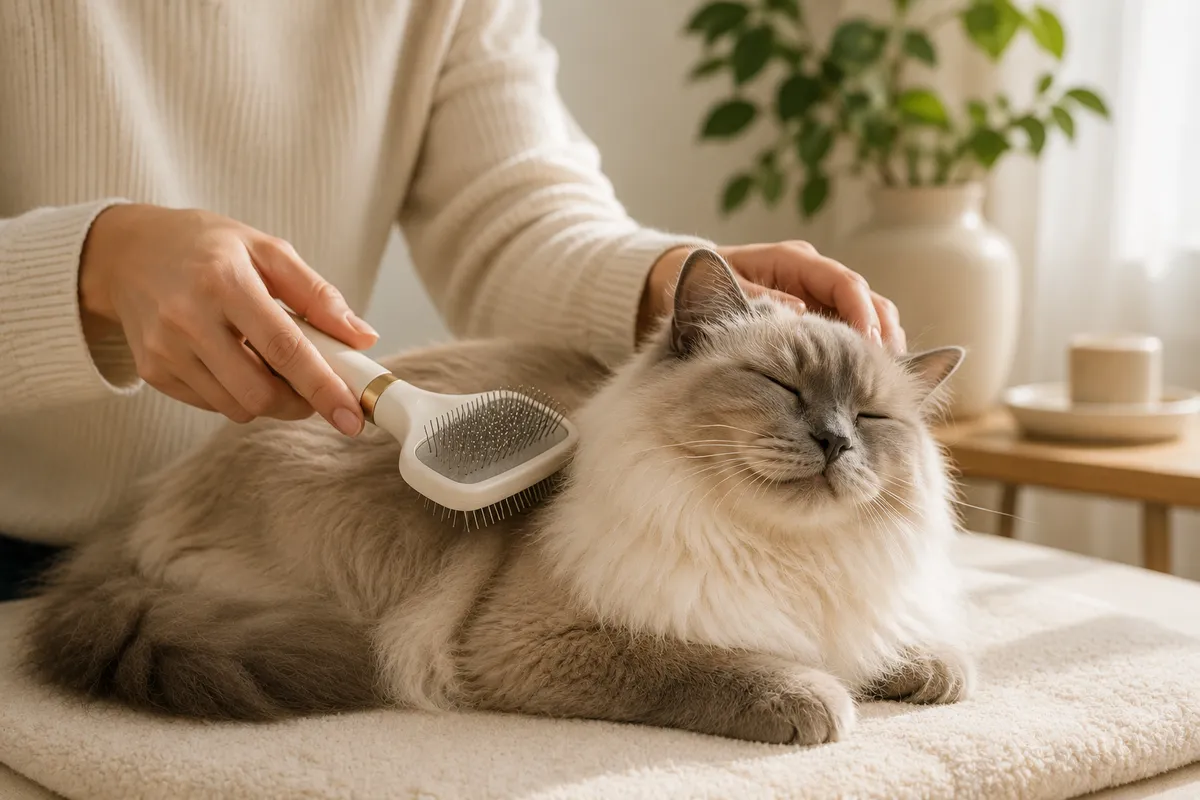
Brushing a cat is a different proposition from brushing a dog, and not because cats are difficult. Cats are sensitive, self-directed, and quick to tell you when something is too much — usually a beat before you'd notice on your own. Brush a cat the way you'd brush a dog, holding her in place and working briskly through the coat, and you'll teach her to flee at the sight of the brush. Do it on her terms, in short calm sessions, and most cats come to tolerate it, and some to genuinely enjoy it.
This guide covers brushing any cat without the stress: how to read her signals, pick the right moment, choose the right tool for her coat, and keep sessions short enough that she stays relaxed. It applies to the easygoing cat and the one who currently hates the whole idea.
The short answer
To brush a cat without stress, choose a calm moment, let her sniff the brush, and start where she likes being touched — usually the cheeks and along the back. Brush gently in the direction the fur grows, in short strokes, and watch her body language closely. Stop at the first sign of overstimulation, like a flicking tail or twitching skin, rather than pushing on. Keep sessions short and end while she's still relaxed.
Why brushing your cat matters
It's a fair question, given how much time cats spend grooming themselves. But self-grooming has limits, and brushing fills the gaps.
Every time a cat grooms, she swallows loose fur — and the more she sheds, the more she swallows, which is what leads to hairballs. Brushing captures that loose fur on the brush before she can ingest it, so regular brushing genuinely cuts down on hairballs. It also lifts dead hair and distributes the skin's natural oils, keeping the coat healthy.
For long-haired cats, brushing isn't optional. A Persian or Maine Coon simply cannot keep a long, dense coat mat-free on her own. Mats form in the high-friction areas — the armpits, behind the ears, the belly, the back legs — and once formed they pull on the skin, trap moisture, and become genuinely painful. Regular brushing is the only thing that prevents them.
And there's the quieter benefit, the same one that applies to dogs: running a brush and your hands over your cat regularly means you notice changes early — a lump, a scab, a sore spot, a patch she's over-grooming. You won't diagnose anything, but you'll catch it sooner. If your main concern is fur on every surface of your home, it's worth understanding how to reduce cat shedding as a whole, of which brushing is the biggest piece.
Reading your cat before you start
This is the part that has no equivalent in dog grooming, and it's the difference between a calm cat and a bitten hand. Cats give clear signals about how much handling they want, and brushing goes well only when you respect them.
Signs she's relaxed and open to it: loose posture, slow blinks, leaning into your hand, a tail held softly, gentle purring, kneading.
Signs she's reaching her limit — stop here:
- Tail flicking, thumping, or lashing
- Skin rippling or twitching along her back
- Ears flattening or rotating back
- Turning her head sharply toward your hand or the brush
- Going tense or still, or a low growl
- Pupils widening
That cluster of signals is petting-induced overstimulation — the cat has hit her threshold for being handled. It almost always comes a few seconds before a swat or a bite. The whole skill of brushing a cat is learning to stop at the tail-flick, not the bite. Push past those signals and you don't just risk a scratch; you teach her that brushing ends badly, and the next session is harder.
How to brush a cat without stress, step by step
The method is built around her comfort, not finishing the coat.
Step 1 — Pick the right moment
Don't initiate a brushing session with an alert, playful, or agitated cat. Wait for the calm, sleepy part of her day — after a meal, in a sunny spot, when she's already settled. A relaxed starting point is half the battle.
Step 2 — Let her investigate the brush
Set the brush down and let her sniff it. Let brushing be something that happens near her before it happens to her. With a cat who's had bad experiences, you might spend the first several sessions just letting her get used to the brush's presence, rewarding calm with a treat.
Step 3 — Start where she likes to be touched
Most cats enjoy being stroked on the cheeks, under the chin, and along the back — the same places they rub against you. Begin there. These are the lowest-stress zones and they let her associate the brush with the petting she already likes. You'll know it's going well when she leans in or starts to purr.
Step 4 — Brush gently, with the grain
Use short, light strokes in the direction the fur grows, head toward tail. Let the brush glide; never press or scrub. A cat's skin is thin and far more sensitive than a dog's, so a tool and a touch that would suit a dog can be too much for a cat.
Step 5 — Watch her, constantly
This is the step that runs through all the others. Keep reading her body language as you go. The moment you see a tail flick, a skin ripple, or ears going back, pause. Often a short break is enough and she'll settle for a little more. If the signals continue, the session is over — and that's a success, not a failure.
Step 6 — Handle tangles slowly, and skip the danger zones
If you find a tangle, hold the fur at its base between the mat and the skin, and tease it apart gently with your fingers or a comb. The belly, tail, and back legs are the most sensitive areas and where many cats draw the line — approach them last, briefly, and only if she's tolerating it. Never force these areas.
Step 7 — End early and on a good note
Stop while she's still relaxed, ideally before she asks you to. A short, pleasant session that ends well does far more for next time than a complete one that ends in a struggle. Finish with the petting or treat she enjoys.
Brushing a cat that hates it
If your cat already dislikes brushing, the approach is the same as above but slower, broken into much smaller steps over many days. The principle: rebuild the association from bad to neutral to good. For a detailed method, see our guide on how to brush a cat that hates it.
- Shrink the session. Aim for ten seconds of brushing, then stop and reward. Ten good seconds beats two forced minutes.
- Desensitize to the brush itself. Leave it out where she can investigate it. Touch her with it without brushing. Reward calm at every stage.
- Never corner or restrain her. A cat who feels trapped will panic, and that fear compounds with every session. She must be free to leave.
- Use the right tool. A harsh or wrong tool turns brushing into something genuinely uncomfortable, which no amount of patience overcomes. The right brush for her coat matters enormously — our guide on how to choose a grooming brush covers what suits different coats.
- Stop while it's still good. Always end before her threshold, so the memory she keeps is a calm one.
If your cat reacts to brushing with what looks like pain rather than dislike — flinching hard, crying out, or guarding one specific spot — that's different from overstimulation and worth a veterinary check.
Coat-type considerations
How you brush, and how often, depends mostly on coat length.
Short-haired cats
Short coats are low-maintenance. A soft brush or a rubber grooming mitt used once or twice a week removes loose fur and feels to the cat much like being petted, which makes these sessions the easiest to keep positive. Matting is rarely an issue.
Long-haired cats
Long-haired breeds — Persians, Maine Coons, Ragdolls, and similar — need far more attention, ideally a short brushing most days. Their dense coats mat quickly in the armpits, behind the ears, the belly, and the back legs. Work in small sections down to the skin, and follow with a comb to find tangles your hand misses. Skipping even a few days lets mats establish, and mats are both painful and hard to remove. Daily little-and-often is far kinder than an occasional long session.
How often to brush a cat
As a general guide: short-haired cats once or twice a week, long-haired cats most days. Like dogs, cats tend to shed more heavily in spring and fall, so increasing frequency during those weeks helps manage loose fur and hairballs. Older cats and overweight cats often groom themselves less effectively and may need more help from you, particularly over the lower back and hindquarters they can't easily reach. The reliable rule is the same as for any coat: brush often enough that mats never get a chance to form.
Why brushing a cat isn't like brushing a dog
If you've groomed a dog, it's worth consciously unlearning some of it before you start on a cat. The calm, sectioned approach to brushing a dog works because most dogs tolerate sustained, methodical handling. Cats generally don't. Three differences matter most:
- Threshold, not duration. A dog will often sit through a full grooming session; a cat has a handling threshold that, once crossed, ends things abruptly. You're working in short bursts, watching for that threshold, rather than aiming to finish.
- Skin sensitivity. A cat's skin is thinner and more reactive, so the firm tools and pressure that suit a thick double-coated dog are too much. Lighter tool, lighter hand.
- Control belongs to the cat. A dog can be gently positioned and will usually accept it. A cat who feels restrained will struggle and remember it. She needs to be free to walk away — paradoxically, that freedom is what makes her stay.
Hold those three in mind and the rest of brushing a cat follows naturally.
When to pause and contact your veterinarian
Brushing is gentle care, but a cat's coat and skin can signal things that need more than a brush — and cats are experts at hiding discomfort. Pause and contact your veterinarian if you notice:
- Pain at a specific spot — flinching, crying out, or guarding one area, which can mean an injury or soreness under the coat
- Tight or widespread matting close to the skin, which is safest removed professionally rather than cut at home
- Red, flaky, scabbed, or smelly skin, or any open sores beneath the fur
- A sudden change in grooming — either a cat who stops grooming and looks unkempt, or one who over-grooms a patch bald
- Bald spots or hair coming out in clumps, as opposed to normal seasonal shedding
- A coat that turns greasy, dull, or matted across the body, which can reflect an underlying health or mobility issue
A change in how a cat grooms herself is one of the clearer early signals that something is off, precisely because cats are so fastidious. When grooming habits change suddenly, it's worth a veterinary opinion rather than simply brushing more.
Brushed the right way — slowly, briefly, and always on her terms — grooming stops being something your cat endures and becomes a few quiet minutes she allows, and eventually seeks out. The goal was never a perfectly brushed coat in one sitting. It's a cat who doesn't run when she sees the brush.
Key Takeaways
- Cats do best with short, calm brushing sessions on their own terms — let the cat come to you rather than restraining her.
- Brush in the direction the fur grows, starting with areas cats enjoy being touched, like the cheeks and along the back.
- Long-haired cats need brushing most days to prevent mats; short-haired cats are usually fine once or twice a week.
- Watch body language closely — a flicking tail, flattened ears, or skin twitching mean stop, not push on.
- Painful spots, mats tight to the skin, sudden over-grooming, or bald patches are reasons to see your veterinarian.
Frequently asked

The PASLUNA Editorial Team creates expert-backed educational content focused on pet grooming, coat care, shedding management, and pet wellness for dogs and cats.
 Cat Grooming
How to Reduce Cat Shedding at Home
A calm, practical routine for managing cat shedding — what actually helps, what doesn't, and when loose fur is worth a vet's attention.
 Dog Grooming
How to Brush a Dog the Right Way (Step-by-Step)
A calm, step-by-step ritual for brushing any coat type — how to do it well, how often, and what a healthy coat looks like.
 Dog Grooming
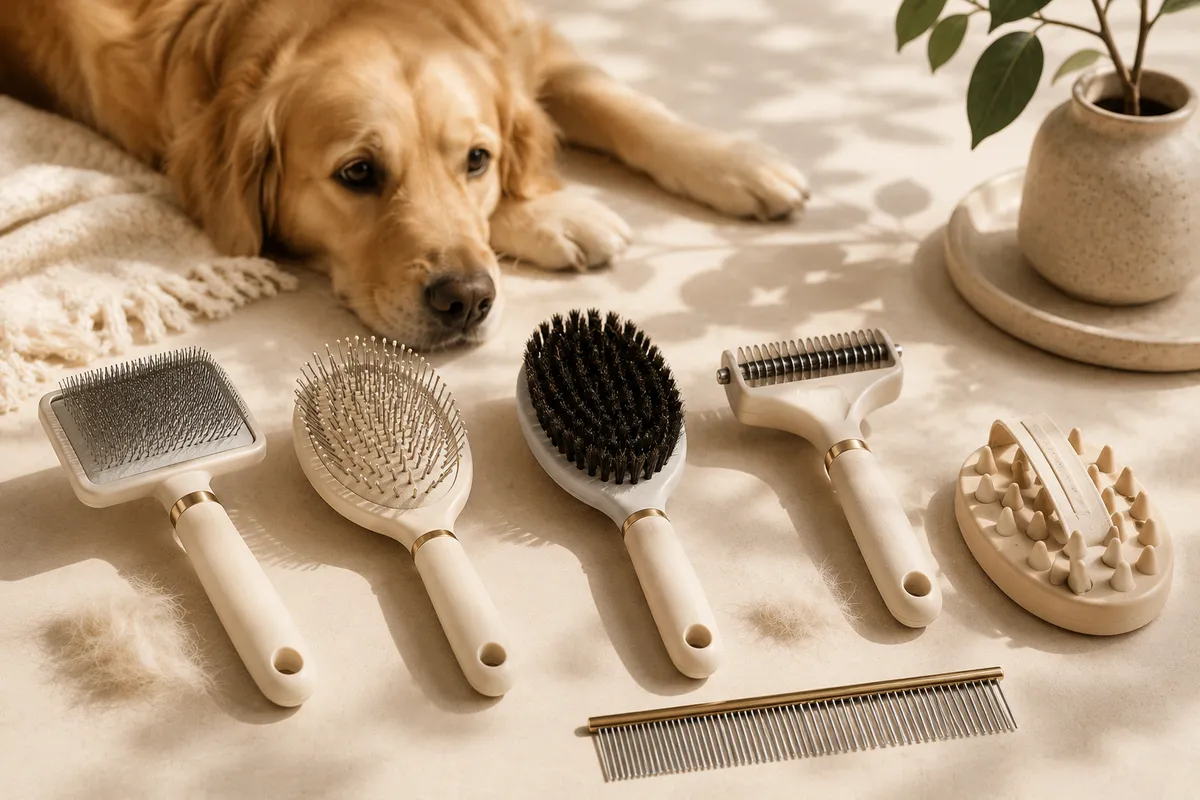
How to Choose the Right Grooming Brush
A plain guide to grooming brushes — what each type does, which suits your pet's coat, and how to match the tool to the job.