How Often Should You Brush Your Dog?
How often you should brush your dog is one of those questions with a frustrating real answer: it depends. But it depends on a small number of things you can actually see and feel — mostly the coat on your dog right now. Get the frequency right and brushing prevents mats before they form, keeps shedding off your furniture, and stays a calm few minutes rather than a battle with a matted coat. Get it wrong in either direction — too little or too much — and you feel it.
This guide gives you a clear schedule by coat type, the factors that move that schedule up or down, and a simple way to build a routine you'll actually keep. (For the technique itself, see our guide on how to brush a dog the right way. Cats run on a different rhythm entirely — that's covered in how to brush a cat without stress.)
The short answer
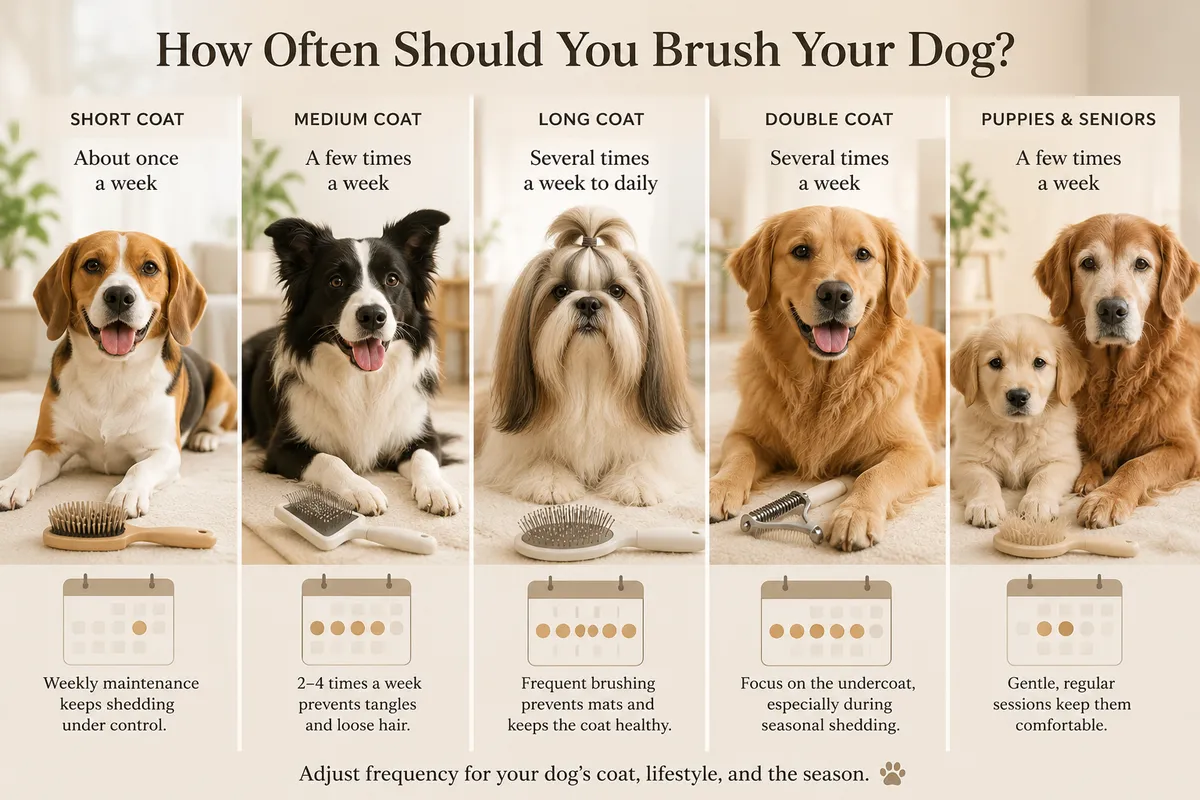
How often you should brush a dog depends mostly on coat type. Short coats are usually fine about once a week, medium and long coats benefit from a few times a week up to daily, and dense double coats need brushing several times a week — more during spring and fall shedding seasons. The most reliable rule isn't a number, though: brush often enough that you never find a mat.
Why brushing frequency matters
Frequency is the difference between brushing as maintenance and brushing as rescue. Brush on the right rhythm and each session is short, because there's never much to do — a little loose hair, a tangle or two caught early. Skip too many sessions and small tangles compact into mats, which pull on the skin, trap moisture, and turn a calm five minutes into an uncomfortable ordeal for your dog.
There's a coat-health reason, too. Regular brushing distributes the skin's natural oils along the hair, which is part of what keeps a coat soft and quietly glossy rather than dull. And consistent sessions mean you're running your hands over your dog often enough to notice changes early — a new lump, a sore spot, a tick after a walk. None of that is a diagnosis, but spotting it sooner is always better.
Finding the right frequency also helps with the thing most owners are really asking about: hair on everything. Brushing doesn't stop a dog from shedding, but doing it often enough catches that hair on the brush before it lands on your sofa. If shedding is your main concern, it's worth understanding why dogs shed in the first place so the routine you build actually targets it.
How often to brush a dog, by coat type
Coat type is the single biggest factor. Here's a realistic baseline for each.
Short coats — about once a week
Short-coated dogs like the Labrador Retriever, Beagle, and Boxer are the most forgiving. A weekly session with a soft brush or a rubber curry-style mitt lifts loose hair and brings out shine. There's little risk of matting, so the focus is simply consistency. One caveat: some short-coated breeds, the Labrador among them, carry a dense double coat under that tidy outline and shed more than they appear to — they often do better with two sessions a week.
Medium coats — a few times a week
Medium coats, like those on a Border Collie or Australian Shepherd, have enough length to tangle in the high-friction areas: behind the ears, under the legs, around the collar. Two or three sessions a week usually keeps them smooth, with a comb to check those friction points.
Long coats — most days
Long coats — think Shih Tzu, Maltese, or Afghan Hound — are the least forgiving of a missed week. Tangles form quickly and turn to mats if left. These coats do best with very frequent, often daily, short sessions: brush down to the skin in small sections and follow with a comb to confirm there are no hidden knots. Little and often is far easier on the coat than a weekly marathon.
Double coats — several times a week, more in shedding season
Double-coated dogs — the Golden Retriever, Siberian Husky, and German Shepherd among them — have a soft, dense undercoat beneath a coarser topcoat. The undercoat sheds heavily in seasonal cycles, the period many owners call a "coat blow." Aim for several sessions a week year-round, increasing to daily during spring and fall when the undercoat lets go. The goal is to lift the loose undercoat by brushing; a double coat should never be shaved down, as it insulates against both heat and cold.
What changes how often you should brush
Coat type sets the baseline. A few things move it up or down:
- Shedding season. Most dogs shed more heavily in spring and fall, and double coats dramatically so. Expect to roughly double your usual frequency during those weeks.
- Coat length and texture. A curly or wavy coat, like a Poodle's, traps loose hair within the coat instead of dropping it, so it mats easily and needs frequent brushing regardless of length.
- Activity and lifestyle. A dog that hikes, swims, or rolls in the yard picks up debris and tangles and will need more frequent attention than a mostly-indoor companion.
- Age and health. Older dogs, or dogs recovering from illness, sometimes groom themselves less and need more help from you. Skin sensitivities may call for gentler, less frequent sessions — your veterinarian can advise.
- Whether tangles are appearing. This is the real-time signal. If you're finding tangles between sessions, you're brushing too rarely for that coat. If the coat is always smooth, your rhythm is right.
How long should each brushing session be?
Frequency matters more than duration, and shorter sessions are usually better than longer ones. For most dogs, a few minutes is plenty: long enough to work through the coat in sections, short enough that your dog stays relaxed. A short-coated dog might take only two or three minutes; a long or double coat in full shed might take ten to fifteen, ideally broken into calm passes rather than one marathon.
The signal to stop isn't a finished coat — it's your dog's patience. Ending a little early, while your dog is still settled, does more to keep brushing pleasant than pushing to get every last hair. If the coat needs more work than one calm session allows, it's a sign to brush more often, not longer.
Does the brush you use change how often you need to brush?
Yes, more than most owners expect. A tool suited to the coat removes more loose hair and works through tangles in fewer passes, so the same frequency goes further. The wrong tool drags, misses the undercoat, and leaves you brushing more often to get the same result — while being less comfortable for your dog. A pin or slicker-style brush with rounded tips suits most coats; dense double coats often need an undercoat tool as well. If you're not sure what fits your dog, our guide on how to choose a grooming brush breaks it down by coat type.
How to build a brushing routine that sticks
The best schedule is the one you actually keep. A simple way to make brushing routine rather than a chore:
- Identify the coat type — short, medium, long, or double — and take the baseline frequency above as your starting point.
- Set that baseline as a loose weekly target rather than a rigid rule.
- Anchor it to an existing habit. Brushing after an evening walk, when your dog is already tired and settled, is far easier to sustain than a session you have to remember to start.
- Adjust to the season and the coat. Increase frequency in spring and fall, and if tangles start showing up between sessions, add one more.
Keep each session short and calm, and stop while your dog is still relaxed. A consistent dog grooming routine of brief, regular sessions does more for a coat than occasional long ones — and it keeps your dog willing to sit for the next one.
Common mistakes dog owners make
- Brushing on a fixed schedule that ignores the coat. "Once a week" is right for a Beagle and far too little for an Afghan Hound. Let the coat, not the calendar alone, set the pace.
- Only brushing the topcoat. On medium, long, and double coats, the surface can look fine while tangles form underneath. Part the fur and brush down to the skin.
- Over-brushing one spot. More passes over the same area, or too much pressure, can leave the skin pink and irritated. Light and even beats hard and repeated.
- Letting shedding season catch you off guard. If you keep your usual frequency through a double coat's spring blow, the loose undercoat mats faster than you can keep up. Increase early.
- Brushing only when it's already bad. Waiting until you can see loose fur everywhere means you're always doing rescue grooming. Frequency is prevention.
Signs you're brushing too little — or too much
Your dog's coat tells you whether your rhythm is right.
Too little:
- Tangles or mats appearing between sessions
- Visible loose fur on the coat and around the house
- Sessions that feel like hard work because there's so much to remove
Too much, or too hard:
- Skin that looks pink or irritated after brushing
- Your dog growing reluctant or flinching during sessions
- Thinning or broken hair in a frequently brushed spot
The right frequency sits in the middle: the coat stays smooth, your dog stays relaxed, and each session is short.
When to pause and contact your veterinarian
Brushing is gentle, routine care, but it sometimes surfaces things that need more than a brush. Pause the session and contact your veterinarian if you notice:
- Pain or flinching at a specific spot, which can signal an injury, infection, or soreness under the coat
- Bleeding, scabs, or broken skin — never brush over these
- Mats tight against the skin or covering a large area, which are safest removed by a groomer or veterinarian rather than cut out at home
- Redness, heat, odor, or constant licking in one area, which can point to a skin issue
- A sudden change in shedding — far more or far less than is normal for the breed and season — or new bald patches
A change in how much your dog sheds isn't always about grooming frequency; it can reflect diet, stress, or health. If adjusting your routine doesn't settle it, it's worth a veterinary opinion rather than simply brushing more.
Set the rhythm to the coat, ease it up when the seasons turn, and keep the sessions short and kind. Done that way, brushing stops being a task you remember to do and becomes a quiet, regular part of your week — the kind your dog comes to expect, and even enjoy.
Key Takeaways
- How often to brush a dog depends on the coat: short coats about weekly, medium and long coats a few times a week to daily, dense double coats several times a week.
- Increase frequency during spring and fall shedding seasons, when double coats let go of their undercoat.
- The simplest rule: brush often enough that you never find a mat.
- Consistency matters more than session length — little and often keeps a coat tangle-free, and over-brushing one spot can irritate the skin.
- Persistent mats, skin irritation, or a sudden change in shedding are reasons to talk with your veterinarian.
Frequently asked

The PASLUNA Editorial Team creates expert-backed educational content focused on pet grooming, coat care, shedding management, and pet wellness for dogs and cats.
 Dog Grooming
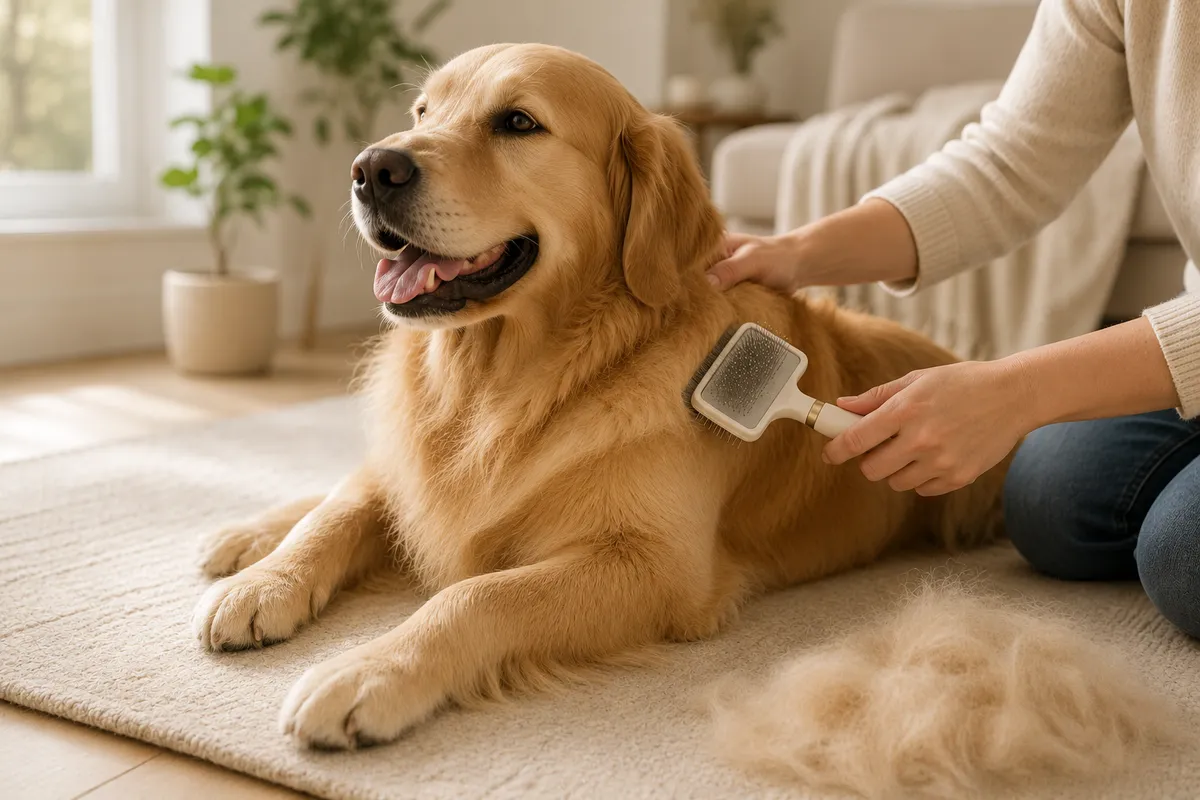
How to Brush a Dog the Right Way (Step-by-Step)
A calm, step-by-step ritual for brushing any coat type — how to do it well, how often, and what a healthy coat looks like.
 Shedding
Why Does My Dog Shed So Much?
Why dogs shed, what counts as normal versus excessive, and how to tell ordinary seasonal shedding from a sign worth a vet visit.
 Dog Grooming
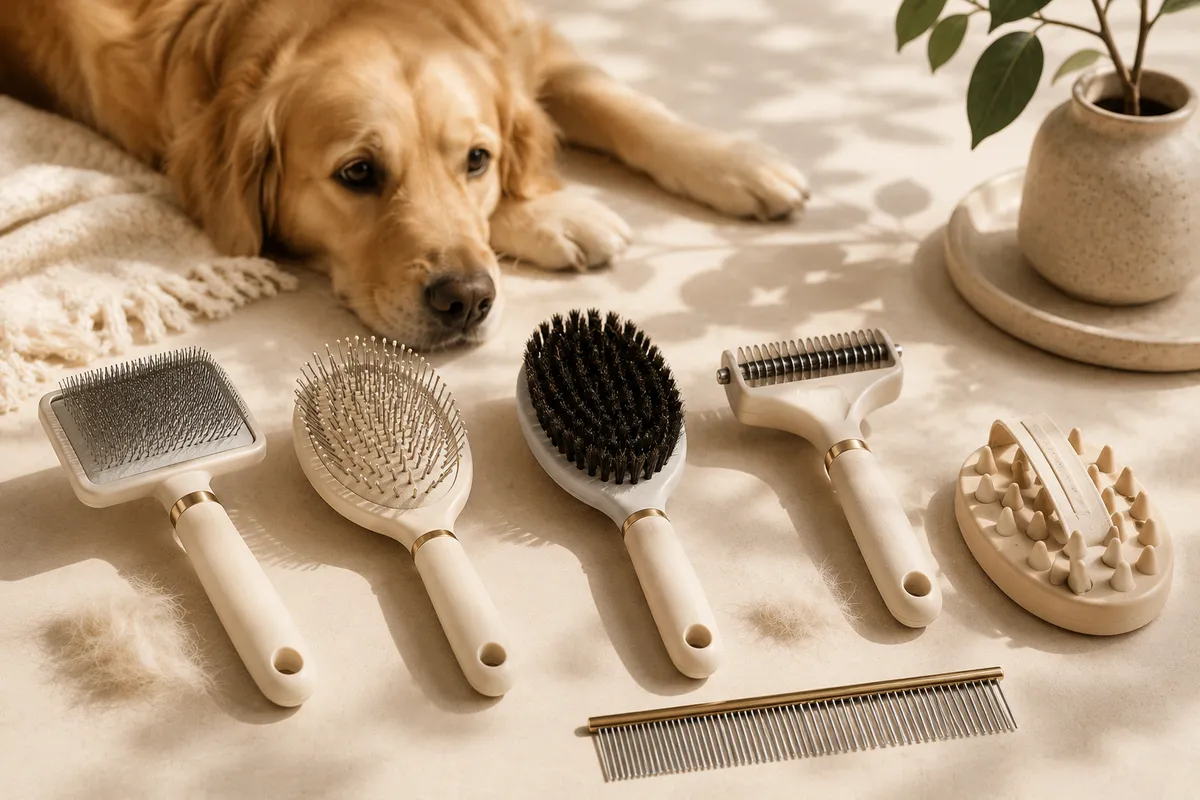
How to Choose the Right Grooming Brush
A plain guide to grooming brushes — what each type does, which suits your pet's coat, and how to match the tool to the job.